Learn Center
What Is Knowledge Management?
Knowledge management is the process of systematically capturing, organizing and sharing information and know-how within a company to help employees do their job more efficiently. In this guide, we will walk you through the elements of knowledge management and how you can make knowledge management more efficient for your company.

Modern day economies thrive on knowledge and information, which makes knowledge management one of today’s companies’ most important assets. An effective knowledge management strategy can solve myriad problems in companies and affect many of its day-to-day processes.
A McKinsey Global Institute Report shows that a well-run knowledge management system can reduce the time it takes to find information by up to 35%, as well as raising productivity across an organization by 20-25%.
Knowledge management definition
Knowledge management is basically any system that can help people in a company or organization to not only access but share and update (business) information and knowledge.
The term itself refers to a group’s collective knowledge being organized, captured, and used, as well as the impact of the knowledge being analyzed. When it comes to business, knowledge management can also refer to maintaining an internal wiki or portal where a company keeps specific knowledge that is related to it.
Knowledge is usually divided into two categories: tacit and explicit.
Tacit knowledge is a type of knowledge that covers what a person knows how to do, but can’t necessarily explain how to do. This knowledge can be skills, experiences, and ideas that aren’t written down anywhere and can’t really be expressed. People usually aren’t aware that they have this knowledge and how valuable it is to others.
Explicit knowledge is also called documented knowledge. It’s the type of information that can easily be expressed and shared, and any information that an organization has documented would be classed as explicit knowledge (like datasheets, research reports, articles, etc.).
Why is knowledge management important?
In any organization, no matter how big or small, knowledge is very often undocumented, hard to find, and easy to lose. Employees who have been with a company for a long time and then quit, retire, or are let go can take huge amounts of knowledge with them, which costs a company real money to rebuild. Hard drives and paper records can also be lost, damaged, or destroyed by accident, so relying on one person’s memory or one physical copy is always a risk.
That’s what makes knowledge management important: without it, employees waste time looking for, or recreating, knowledge that already exists, simply because the system in place isn’t set up right.
Using an effective knowledge management system can:
- Reduce the cost that comes with inefficiency because knowledge becomes readily available, accurate, and accessible.
- Allow remote or distributed teams to access the knowledge they need to.
- Spend less time recreating knowledge that already exists.
- Get information sooner and more easily.
- Make fewer mistakes.
- Standardize processes across the business.
- Help employees make informed decisions.
- Provide customers and employees better service.
- Increase the speed of innovation.
- Increase the speed and effectiveness of onboarding.
The reason most knowledge management efforts stall isn’t the tool, it’s upkeep. A wiki with a handful of outdated pages loses people’s trust faster than having no wiki at all: after two or three wrong answers, employees stop checking it and go back to asking a person directly, and the whole system quietly dies. Before rolling out a knowledge management system company-wide, assign an owner to each section who is responsible for keeping it current, not just whoever wrote the first draft. That one decision predicts whether the system is still in use a year later more than which tool you picked.
How to use knowledge management tools to benefit your company?
In order to be as effective as possible for a company, knowledge management needs to have a few qualities.
- Dynamic: companies aren’t static, so knowledge management systems shouldn’t be either. The system should evolve and change as the company grows.
- Current: real-time knowledge is very valuable, and all information should be up-to-date at all times so that business decisions are based on information that’s most accurate. Setting up a content review flow to keep your knowledge up-to-date is the key to ensure engagement for your internal knowledge base.
- Accessible: knowledge management systems should be easily accessible to all employees as well as easy for them to contribute, while still letting you set different permissions based on user groups so you can control who can access certain content that might be more sensitive.
- Stored well: there should be a system that stores and categorizes knowledge in a single place.
- Support a wide range of integrations: knowledge management systems should work well with existing workplace tools.
- Encourage curiosity: employees should have a safe space to ask and answer questions as well as share knowledge.
- Protect employees’ private data
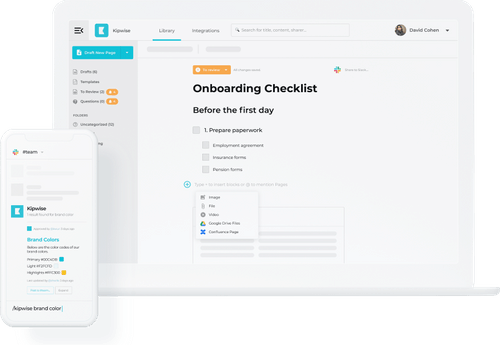
This might sound like a lot to manage, but the right knowledge management tool isn’t difficult to find. Kipwise is a knowledge management tool that helps teams build up their company knowledge hub easily, with Slack integration, a Chrome extension, and connections to Google Drive, Trello, Airtable and more, so you can save and retrieve team knowledge easily, wherever you need it.
Using its real-time collaborative editor with rich embedding options, your team can edit the same doc at the same time and create visually appealing documentation easily. You can also set designated reviewers for your collections, and Kipwise will remind them to review the content regularly to ensure your knowledge base is always up-to-date and accurate.
Looking for an effective knowledge management tool for your team?
Check out Kipwise, your company wiki solution with built-in workflows to drive collaboration and productivity.