Learn Center
Synchronous vs Asynchronous Communication
As the popularity of the Work-From-Home model spurs on, more teams have to shift their balance towards having more asynchronous communication. In this article, we will discuss how you can embrace a hybrid model with synchronous and asynchronous communication.
Even before the pandemic, organizations used both synchronous and asynchronous communication in the workplace. 16% of companies in the world are fully remote teams. As the popularity of the Work-From-Home model spurs on, we can expect more workers to run on asynchronous communication.
Relying on different forms of communication matters most when teams are spread across time zones, roles and working hours. A team with people in different cities and countries doesn’t share the same 9-to-5, so managers need more than one channel to keep everyone in the loop. Sticking to only synchronous or only asynchronous communication limits how well that works: a hybrid of both lets each person use the channel that fits their schedule and the task at hand.
Synchronous vs. Asynchronous communication
Synchronous communication
This type of communication is live and interactive. For synchronous communication to take place, participants have to be present and discuss things in real time. Synchronous communication is tied to many traditional workplaces, since it is quite straightforward and runs by a schedule. These sessions are planned around a set agenda and time frame so participants can set aside a place and time. In synchronous communication (think: in sync), employees can benefit from a wide range of perspectives and speaker expertise during real-time dialogue.
Examples of synchronous communication
In the office environment, synchronous communication can take place in many forms. Some examples are physical meetings, brainstorming sessions, over-the-desk conversations with a coworker, or one-to-one meetings in a manager’s office. This could take place in a remote work environment as well, such as over the phone or live video conference.
Asynchronous communication
On the contrary, asynchronous communication is interaction that takes place without being in real-time. There is no constant dialogue and participants can respond in their own time. To facilitate efficient responses, participants will usually set a deadline. Otherwise, an obligation to continue the interaction could be part of workplace etiquette. Still, asynchronous communication usually takes place when situations and responses aren’t time-sensitive, so employees can go at their own pace.
Examples of asynchronous communication
The most common form of asynchronous communication is email. Asynchronous communication in the office can also take place through pre-recorded tutorials, knowledge banks, company wikis, discussion boards and messaging software. All these channels of communication provide employees with the flexibility of reading and responding when they are available.
What are the benefits of asynchronous communication?
While asynchronous communication is most often associated with remote work environments, the reality is that it can benefit all types of workplaces. One of the biggest advantages of asynchronous communication is that self-directed employees can handle things on their own timetable, rather than upper management dictating exactly when they must be available.
Here are some of the benefits of asynchronous communication.
Ideal for busy employees
Async communication matters more as work-life balance becomes a bigger factor in where people choose to work, with 72% of people taking work-life balance seriously when searching for a job. Letting employees answer messages on their own schedule, instead of dropping everything for a meeting, is one concrete way to give them that free time back.
Allows more time to go through content
When recipients are given sufficient time to respond, they can go through the material (e.g. tutorials, emails and messages) to think of appropriate responses. Perhaps they may need more time to absorb information or come up with specific questions. Asynchronous communication can promote more productive conversations as it allows time for further reflection.
Accessible at any time and place
With geographically separated teams, or even teams that don’t work during the conventional office hours, there may be some difficulty in finding a shared time for scheduled communication. Asynchronous communication allows for conversations to be easily retrieved at any given time and place. Usually, all it needs is a working internet connection.
Saves on cost and time
Standard working weeks should typically last 38 to 40 hours. However, reports have shown that some workers can hit up to 50 hours a week. Asynchronous communication cuts down on the time to commute to and from scheduled meetings. Responses are also kept short and to-the-point, without the redundant back and forth. Asynchronous communication also doesn’t need a dedicated space, which can otherwise cost money to book or rent.
When to choose synchronous vs. asynchronous communication
While asynchronous communication has its benefits, there are still situations where synchronous communication works better.
For starters, synchronous communication enables real-time interaction, and that kind of synchronous collaboration keeps ideas flowing between people. Participants can throw out a new idea and get feedback on it right away, which is why it works well for brainstorming sessions where a team needs to build on ideas on the spot. Employees who learn best with direct guidance may also prefer synchronous communication, since they get support and instruction in the moment.
A quick test: if a conversation needs more than two or three replies to reach a decision, it probably shouldn’t be asynchronous at all. Move it to a call instead. Long back-and-forth threads don’t actually save time, they just spread the same meeting across a whole afternoon, and by the last reply most people have lost track of what was decided. Treat async as the default for anything one person can answer in a single message, and switch to synchronous the moment a decision needs real back-and-forth.
Asynchronous communication best practices
If your organization is new to asynchronous communication, or it hasn’t worked well so far, here are a few practices that help.
Sync on asynchronization
Before switching over to a new methodology, it is important to align your employees with the new workplace culture. Ensure that everyone is aware of the changes and how to effectively manage communication going forward.
Think in the perspective of other participants
Asynchronous communication can be counterproductive if employees do not communicate in a way that is understandable to the recipient. Encourage employees to send clear and articulate messages, stick to deadlines and be transparent about feedback.
Use the right tools
Proper communication relies heavily on the functionality and usability of an organization's toolset. If channels are constantly malfunctioning or blocking out notifications, it can be detrimental to effective communication.
For more tips on how to improve asynchronous communication, check out our blog post 5 ways to improve communication for remote teams.
The best asynchronous communication tool in 2021
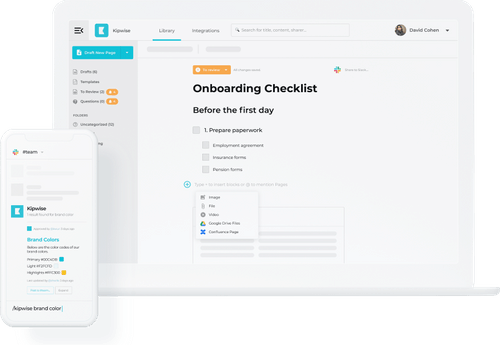
The right communication channels make sure messages are sent, received and stored where people can find them again. Kipwise centralizes that knowledge in one platform, so teams can search past decisions and documentation instead of digging through old messages. With integrations for tools like Slack and OneDrive, it keeps knowledge and communication in one place instead of scattered across separate apps.
Looking for ways to better share information in the team?
Join 10,000+ users using Kipwise to better share team knowledge